About Me

My photo
A good traveler has no fixed plans, and is not intent on arriving - Lao Tzu

Saturday, November 15, 2008

Bon Om Tuk - The Grand Finale

Ah, the Water Festival. Once again, this amazing experience has completely altered my attitude towards Cambodia - and for that I will be forever grateful, especially now that I'm high tailing it for the border, possibly never to return. As I wandered around the city on that last morning of celebration, I was a little concerned by the apparent lack of people on the streets. I thought maybe the million plus visitors were trying to get a jump on the long journeys back to their home towns and villages. Ha, what a sucker I was.....everyone was just sleeping off the hangovers from the night before. By 2:00 the party was back in full swing with, if you can believe it, even MORE excitement in the air. Once more I dove headlong into the (very polite and orderly) masses and managed to make my way down to the "Foreign Visitors Viewing Area" on the river bank for the boat racing finals. As it turns out, I was in distinguished company - just down river sat the King of Cambodia. I caught occasional glimpses of his royally bald head when he stood to applaud the racers. Having a seat so close to the King and other assorted dignitaries ensured that I got an up close view of all the boats as they did their victory laps back upstream. Between the Cambodian's excitement due to the presence of royalty and the copious amounts of alcohol they had obviously been drinking in the hot sun all day, all the boat crews put on quite a show after their heats. As entertaining as they were in front of the stuffy officials and subdued foreigners, they really let loose as soon as they paddled a little further upstream and got in front of the hometown crowds. Then the partying really began....as it should.

I had a little trouble following all the action since the play by plays were in Khmer, but it was obvious that the races were winding down in frequency. Finally, I could just make out the King overseeing some sort of ceremony down on his stretch of river bank. Then two beautifully ornamented boats manned by crews in royal regalia began the long paddle upstream past the crowds to the starting line. All of the other boats joined the procession and before long they were out of sight. Not quite sure what was going on, but also realizing that none of the Cambodians were leaving their seats, I waited with a couple of Brits I had been watching the races with. Suddenly, a MASSIVE flotilla of boats appeared around the upstream bend, heading for the red ribbon tied off between mid-river buoys that now marked the finish line. But they weren't paddling very hard - this was just a ceremonial race, led of course, by the royal boats. To the thunderous applause, shouts, and chanting of the crowd, the entire mass of boats made its way to the finish line, with the King's boats breaking the ribbon. This year's boat racing was over.

The rest of the evening was devoted to a massive firework display over the river and a parade of lights: barges covered in neon-laced scaffolding representing.....well, I'm not sure what they were representing. There were big turtles, a firebreathing rooster, an oil derrick, and a back hoe among other things. At any rate, the entire spectacle, from the first boat races of the day to the late night street party, was by far one of the coolest things I've seen in all of my travels. A perfect way to say goodbye to Phnom Penh.

Thursday, November 13, 2008

Bon Om Tuk: It's Water Festival Time!

It's amazing how one small (or, in this case, rather large) event can completely change your attitude about a place. When I left Phnom Penh a few days ago for my south coast loop, I was a little down on the city. The noise, the dirt, the poverty - it had all gotten on my nerves a bit. Fast forward a week and toss in the biggest festival on the Cambodian calendar and Phnom Penh is a new experience altogether. In fact, it's nothing short of amazing.

I had heard that "Bon Om Tuk" would be a big deal - the population of Phnom Penh doubles as more than a million people flood in from the rest of the country - and, in a very rare moment of (wise) strategic planning, I had reserved a $6 room down by the waterfront in advance. Arriving from Sihanoukville, buses were being stopped about 15 km outside of town. From there it was a tuk tuk taxi to within about 5 blocks of the river, beyond which all motorized traffic had been restricted. Sweating my way through the streets on foot, I made it to the guesthouse, threw my bags in my room, and headed out the door to be immediately swept up in the biggest crowd of people I've ever seen. Although I have no idea how many people were on the streets, the million person figure didn't seem a stretch. People were shoulder to shoulder for blocks and blocks, particularly in the evening. A carnival atmosphere had descended upon the city - vendors, gawkers, picnicers, strollers, strutters, families, tourists, and police clogged all the available open space. Stages for (bad) musical perfomers had been erected in each of the main traffic circles and city parks for entertainment. Neon-covered barges floated up and down the river and a surprisingly sophisticated firework show marked the end of the day - and signaled the beginning of the evenings parties.

For all of the dry-land festivities, Bon Om Tuk is really about the river. Falling in early November each year, it celebrates the "epic victory" of Jayavarman VII over the Chams, who had conquered and occuppied Angkor in 1177. It also marks an annual natural phenomena - at the conclusion of the rainy season each year, the flow of the Tonle Sap river actually reverses direction. For half the year, the river flows into Tonle Sap lake, the biggest in southeast Asia. As the dry season begins, the bloated lake begins to drain and the river begins its normal flow into the Mekong and out to the South China Sea. The locals celebrate this change in the river with boat races...lots of boat races. For three days straight, hundreds (500 this year) of long, skinny, low-riding boats powered by dozens of paddlers race each other on a downriver course set up in front of the royal palace. I'm not sure how long the course is, but you certainly can't see the start from the finish line. It's an absolutely amazing sight - some of the boats have 75 paddlers or more - stroking their way down the river in unison (from a distance they resemble the undulating bodies of caterpillars, especially the teams uniformed in bright green shirts). Once the course has been run, the teams are required to turn around and paddle BACK to the start line and do it all over again. But the upstream run provides an opportunity for some showboating in front of the crowds - chanting, dancing, and paddle slapping are the name of the game.

The races are televised all over the country (and even in Bangkok, reports my Dad) and you're lucky if you actually manage to get through the massive crowds and close enough to the river to see any of the action. Unless you're a foreigner, that is. The Cambodian Tourist Bureau has, in their infinite wisdom, cordoned off a large chunk of riverfront near the finish line (complete with covered viewing stand and padded seats for the softer folks) just for international visitors. After thinking I'd never see the races due to the huge crowds, I stumbled into this little corner of sanity and was promptly escorted by a friendly Cambodian representative to a seat with amazing views. There I sat, transfixed by the crowds, the boats, the races, the capsizes (three that I saw, with over 100 people - sans lifejackets - in the drink) and all the rest of the hoopla for several hours. While I felt a little guilty about my preferential treatment, I figure I deserve a little, especially after all the overcharging my white skin encourages. Today marks the final day of the festival and the word on the street is that, at the conclusion of the championship race this afternoon - presided over by the King, of course - all 500 teams will paddle the course together. Now, that should be a sight.

So, like I said, my feelings about Phnom Penh have be radically changed. The trick will be getting out of town before it reverts back to the drab normalcy that turned me off in the first place. With that in mind, I'm catching an early bus north to Kratie first thing tomorrow morning. Time to start the trip north to Laos.

Tuesday, November 11, 2008

Sihanoukville...bringing out Evan's inner prude

Ok, so Sihanoukville isn't exactly the Cambodian version of Pattaya (the nauseating sun and sex capital of Thailand). Much to my pleasant surprise, it's not even close....yet. But given a little time and better advertising among the international creepy, balding, overweight and lacking in human decency set and Sihanoukville will get there. Today, however, it's a pretty low key port town blessed with a few strips of white sand and a decent road to Phnom Penh. The couple of beaches that haven't been completely privatized by luxury resorts are edged, from one end to the other, with palm-thatched bungalow guest houses, restaurants, and bars. In short.....Evan's version of hell on earth. I won't go on and on bitching and moaning about the Asian beach scene - to each their own, I suppose - but, for the life of me, I just don't see the pleasure in getting loaded on "Mekong buckets" and whatever the cheap and easy drug of the week might be while simultaneously offending locals and fellow travelers alike with gross displays of overweight, hairy, sunburned bodies (Russian men and British women seem to be the worst offenders). The icing on the cake, of course, is the unabashed "relationships for hire" between the losers mentioned above and the local Cambodian women. Who would have thunk it, Sihanoukville has apparently brought out the puritan in me.

I do have to mention that it all makes for an entertaining sunrise stroll on the beach. Sort of like an atomic bomb went of in a neighborhood of neo-hippy communes, sports bars, and cheap brothels. After making sure to kick a little sand on an afro'ed burnout who was passed out in the surf, I shared a little chuckle with the couple of Cambodian kids who was busy sifting cigarette butts, beer bottles, and scraps of roman candles from the beach.

So given all of joys of Sihanoukville, why did I even bother stopping by? For the same reason we can't help staring at car wrecks, I guess. That, and that it made a convenient stop on the road back to Phnom Penh. And Sihanoukville isn't all that bad....the locals are pretty friendly, the weather is spectacular, and I may even head down to the beach for a swim in the Gulf of Siam. I won't be seeing the ocean again for a while so maybe I'll frolic in the waves. And, most importantly, now that I've been here, I'll never lay awake at night thinking "man, I wonder what that Sihanoukville, Cambodia is like?"

Before signing off from S-Ville, I've got to mention one of the most amazing examples of niche-market exploitation I've come across in my travels. There's a transportation company in this part of the country called "G'Day Mate Outback Tours."Ok, whether or not an Australian had or has anything to do with the company is beside the point - other than I would love to believe that a Cambodian actually came up with the idea. Anyway, G'Day Mate provides minibus transport between certain cities with, and I quote, "NO Crazy Overtaking, NO Loud Khmer Music, NO Constant Beeping of Horns, and NO Seat Sharing - You are GUARANTEED 1 Whole Seat per Person!" I love it.....they've won my business.

Monday, November 10, 2008

Southern Cambodia: If I was any more relaxed I'd be dead

As much as I loved the dusty craziness of Phnom Penh (sarcasm intended), I sure enjoyed watching the city vanish from sight through the back window of our bus as we left town. Passing the last remnants of the city's sprawl, I was treated to my first real view of rural Cambodia - and it was spectacular. The rainy season has apparently been kind this year because fields of bright green, waist-high rice stretched out in all directions as far as I could see. The only things breaking the pancake flat contour of the horizon were the scattered palm trees lining irrigation ditches or surrounding small stilt homes. In fact, the view was almost good enough to distract me from the drops of water leaking from the overhead a/c vents in the bus. I, however, was one of the lucky ones. Sitting in an aisle seat, I was merely being hit by the occassional stray drop. The poor people in the window seats directly under the vents were subject to the full leak. Eventually, the driver's assistant started taping little plastic bags to the roof of the bus in order to collect the dripping water - before long a half dozen were slowly filling with brownish water as they dangled precariously above people's heads. A Buddhist nun eventually threw a fit in Khmer, which was funny but didn't really help the situation. I was secretly hoping that one good bounce would shake a few bags loose, but no such luck. The tape held until we arrived in Kampot.

Kampot, Cambodia is one of the sleepiest little towns I've ever visited in Asia. Maybe one of the sleepiest I've visited anywhere. Once a pretty important river side port town - really the only ocean port in Cambodia (most shipping travels to Phnom Penh via Vietnam on the Mekong) - it was permanently downgraded upon completion of the deepwater port at Sihanoukville, just down the coast, in the 1950's. Three wars in the last 50 years haven't helped either. So you've got several blocks of old French colonial style buildings fronting the river and its palm-lined promenade, a rusty bridge that has probably been on the receiving end of more than a few bombs, and a population that probably consists of as many chickens, dogs, and cows as people. The town has been seeing an influx of full time foreigners over the past decade ("Pot-pats") but even that only translates into a few river side bars/restaurants and a handful of guesthouses scattered around town. In short, it's a beautifully relaxing place with not a whole lot to do.

One of the cool things I did do was to rent a motorbike for a day to explore the stretch of coast to the east, ending at a small village called Kep. Once again, Kep had a hey day - apparently it was the place for wealthy French colonials rest and recreate. After the French, it was the elite of Cambodian society (ie. corrupt government and military officials) who built their villas in the surrounding hills. And then came the war and the whole town was effectively abandoned. Today, Kep is a quiet little place. A few small hotels have sprung up, a handful of guesthouses have been carved out of the forested hills, abandoned villas are either being reclaimed by vegetation or squatted in by local families. It's all going to change soon, I'm sure. A place this beautiful can't stay unadulterated for long.

After a few lazy days in Kampot (the only kind of days in Kampot) my pulse and blood pressure had dipped to dangerously low levels and it was time to move on. Next stop, Cambodia's attempt at Pattaya: Sihanoukville.

Thursday, November 6, 2008

A few days in Phnom Penh are PLENTY

Ah, Phnom Penh. I've been here for four days now - waiting patiently for the return of my passport and visa to Laos - and I'm itching to hit the road again. While there's no denying that the "Penh" is an interesting city, once the main sites and points of interests have been knocked off the list, there's really not much to keep the casual traveler in town. It's hard to compare Phnom Penh to any of the cities that I visited thus far - it's a not small (1.2 million people) but it's one of those spread out places that feels more like an oversize provincial town than a capital city. It's also noticeably poorer than many of the places I've been on this trip. After a day or two it's impossible not to fall into varying stages of "beggar fatigue." The numbers of amputees and otherwise disabled are disheartening. Add to this an over abundance of motorbike taxi drivers (the city has no public transportation at all) and would-be guides hanging on your very move and it's easy to want to hole up in an air-conditioned cafe or bar and never leave. You can't blame the locals for trying to drum up business or welfare. A complete lack of social services and notoriously corrupt government ensure there are no alternatives. Regular power outages, a completely whacked out and unintelligible system for naming streets, sidewalks that serve no other purpose than as a place park cars and collect trash, and the need, for safety's sake, to curtail your activities after dark round out the joys that are Phnom Penh.

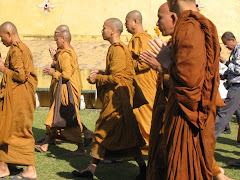
Now, all of that being said, I DO like Phnom Penh. It took a few days but I've managed to track down one of the better fruit dealers in the city market. I've definitely found the best Bangladeshi restaurant in town (lunch and world politics with the owner every day - we bashed Bush and watched the election results come in together). The temples are beautiful, the view of the Tonle Sap river merging with the Mekong is amazing, the traffic is bearable, and even the touts are tolerable - a pleasant "no thanks" works wonders. Watching barefoot, orange-robed monks collect alms from shopkeepers each morning is a classic Asian experience. I'm still having a hard time dealing with the beggars - I'd be completely broke in a couple hours if I gave to all the needy - but that just comes with the territory.

But now, it's time to move on. I'm heading south to the town of Kampot tomorrow and then on to the coast. However, I'll be back. Phnom Penh's central location and the absolute lack of a decent road system in Cambodia ensures that I'll have to pass through the city at least once more. Looking forward to it. Ha!

Wednesday, November 5, 2008

Tuesday, November 4, 2008

A Sobering Reminder....Tuol Sleng (S-21)

It's an unfortunate fact that Cambodian civilization appears to have reached its peak nearly 800 years ago and has been in a steady decline ever since. History has not been kind to the Cambodian people and the savage brutality of the Khmer Rouge that tore this country apart only 30 years ago is fresh in everyone's memory. Trying to sort out the tangled events that led to the deaths of 2 million Cambodians (an educated guess, at best) over three years and eight months is nearly impossible - I can't begin to fathom the depravity of Pol Pot and his followers.
On the surface, Cambodia appears to be just another developing country where daily life is a struggle for most. Just below the surface, however, lies a terrible history affecting almost every single Cambodian. Anyone over the age of 30 lived, and suffered, directly under the Khmer Rouge. Everyone has lost immediate and/or extended family members and the stories are heartwrenching. It seems as though every generation suffers from genocides - the Holocaust, Cambodia, Rwanda, Darfur. The thing that makes Cambodia somehow unique is that there was no rhyme or reason to the killing. Cambodians killed Cambodians. The educated city-dwellers were sent to their deaths by Khmer Rouge leaders who had gone to school in France. Initially, whole families, and even villages, were exterminated based entirely on their connections (real or imagined) to the previous government - which included simply living under that regime. And in the end, the Khmer Rouge, in fits of paranoia, turned on itself and - possibly in a twisted form of ironic justice - began torturing and killing its own.
Tuol Sleng was a notorious detention and torture center that the Khmer Rouge set up at a suburban Phnom Penh high school. Perceived enemies of the regime were sent there - along with their families - to be horribly tortured into giving "confessions" before being taken to the killing fields located on the outskirts of the city. There they were often forced to kneel on the edge of a pit before being beaten on the back of the head with an axe handle or heavy stick. As they lay among other bodies, their throats were slit. Occasionally, with hands bound behind their backs, plastic bags were simply tied over a person's head. The beatings and suffocations were used to save Khmer Rouge bullets. Between 1975 and 1978, 17,000 people of all ages and backgrounds entered Tuol Sleng. Only 7 survived.
Almost immediately after the Khmer Rouge's overthrow in 1979, Tuol Sleng was converted into a memorial and museum. Things remain much the same today as they were in 1980. The rusty barbed wire still surrounds the compound, the cells are still in place, and most disturbingly of all (for me) the tiled floors remain. As none of the former torture rooms or prison cells are cordoned off, I found myself walking on literally the same ground that prisoners were forced to sleep on, or were ultimately tortured and killed on. In addition, the Khmer Rouge were meticulous record keepers. When each prisoner arrived at S-21, their photos were were taken and biographies recorded (including several Americans, Canadians, Australians, and French). Today, the former holding cells contain hundreds, possibly thousands, of these black and white photographs. I've included just a few. Knowing that these people were terrified and facing torture and certain death as their photos were taken was hard to deal with. I won't lie, the visit affected me deeply and I spent the rest of the day in a minor state of depression. I assume it must be the same for visitors to the Nazi concentration camps - it was, after all the same thing.
I left with one question rolling around in my head: Why?

Phnom Penh...piece of cake

As usual, any apprehension I may have had about crossing a remote and little-used border staffed by reportedly corrupt officials bent on separating me from my money was COMPLETELY unwarranted. The trip from Chau Doc to Phnom Penh, although a little longer than anticipated (fighting an unusually swift Mekong current and, of couse, minor boat engine malfuntions), turned out to be a relative piece of cake. After motoring up the Mekong for a few hours, we made it to the Cambodian border by mid-day and turned over our passports and fees for processing. By the time the regular gaggle of food vendors had cleaned my pockets of soon to be worthless Dong, the passports had been signed, stamped, and returned. Good to go! Back on the boat for a few more hours before reaching the first town of any size, along with its paved road. Transfer to a waiting mini-van, and by 8:00pm we were rolling into Phnom Penh.
If there's one thing I hate when traveling, it's pulling into a strange city after dark - and by 6:00 southeast Asia is pitch black. Knowing full well that I was about to be another scammed schmuck, I grabbed a room at the guesthouse where I just "happened" to be dropped off. After a long day of travel, I was in no condition to go looking up and down dark alley ways for an alternative - especially since I had absolutely no idea where I was. I mean, the van driver just told us we were in Phnom Penh. We really could have been anywhere - I wouldn't have known any better. All I knew was that the locals weren't speaking Vietnamese anymore. After dropping my bags, filling my stomach with a plate of vegetable and rice, washed down with a cold beer, I was out.

As I stumbled down the stairs from my room the next morning, I looked out across the city and was happy to find that, instead of being sequestered in a random far-off corner of the Phnom Penh, I was smack dab in the middle of what passes for downtown. The spires and stupas of the Royal Palace looked as though they were a couple doors down and a quick glance at my ratty map showed that I was at least within walking distance of the river front. Both good signs. Phenom Penh isn't a big city, but it's nice to be in the middle of things, especially when your primary mode of transport are your Chacos.

After a morning of wandering (and getting lost) it was plain to see that I had crossed some sort of cultural divide when I entered Cambodia the day before. The Chinese-influenced Vietnam has given way to the Indian-influenced Khmer culture. Phnom Pehn feels much more like Thailand with it's colorful wats (temples), stupas (pagodas), and safron-robe wearing monks. Looking back on it, I don't recall seeing a single robed monk in Vietnam. But suddenly they are everywhere - even sitting next to me in the internet cafe as I type this. At first glance, Cambodia looks and feels poorer than Vietnam, which isn't surprising given its history. But I've just gotten here and before I start making any comparisons, I've got to get out and about. It'll take a few days to get my visa for Laos processed so I've got some time to explore. As for now, I'm just happy to be in Cambodia....wallet intact.

Saturday, November 1, 2008

Welcome to CAMBODIA

Street crime is prevalent in urban areas. Armed robbery and other crime (including sexual offenses) have occurred during daylight hours (even in hotel rooms) in Phnom Penh and Sihanoukville, and in Siem Reap after dark. Foreigners have been robbed, some at gunpoint, and seriously injured. Travelers should not resist armed robbery; any perceived resistance may be met with physical violence, including lethal force. Bag theft has also increased in these areas, including during daylight hours, and Westerners appear to be the main targets. Pickpockets and bag snatchers often target those using local transport. Thieves on motorcycles frequently grab bags and other valuables from tourists riding on the back of motorcycles taxis. Local police rarely investigate reports of crime against tourists and travelers should not expect to recover stolen items.

There are high levels of firearm ownership in Cambodia and guns are sometimes used to resolve disputes. Military weapons and explosives remain readily available to criminals despite efforts by authorities to collect and destroy such weapons. Foreign tourists have been threatened, including with handguns, for perceived slights to local patrons in popular Phnom Penh nightclubs and elsewhere. There are reports of Western deaths resulting from illicit drug use in Cambodia.

Banditry continues in some rural areas - particularly at night in areas between Snoul, Kratie, and Stung Treng in the northeastern provinces. Foreigners have been targeted by ill-disciplined police or military personnel.

Attacks against ship in the South China Sea and surrounding seas have occurred.

There have been a small number of grenade/bomb attacks, although most have been linked to business or personal disputes. There is no evidence to suggest that Western interests have been the targets of these attacks. However, there is a danger that foreigners might get caught up in any further attacks.

(Excerpted from US State Department's Cambodia Country Report)

Great.........