About Me

My photo
A good traveler has no fixed plans, and is not intent on arriving - Lao Tzu

Sunday, December 7, 2008

A stroll through the morning market...

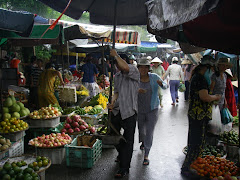
Luang Prabang's morning market is located just down the alley from my guesthouse and I had wandered through it a half dozen times before I actually started noticing how many different things were being sold. Thinking it might be interesting to list everything I saw (and could identify - not easy in Laos), I grabbed a pen, a scrap of paper, and started strolling. The market isn't all that big by Asian standards, just a hundred meters long or so and taking up both sides of a narrow street, but I was surprised by the variety. Dog lovers beware - this may not be your kind of place. Anyway, here's what I found, in no particular order: Plantains (roasted and raw), wrapped bundles of banana leaves, onions (yellow and green), eggs, khai paen (dried Mekong river moss fried with sesame seeds), smoked whole chickens, bullfrogs (dead or still hopping), coconuts, water melons, green beans, a half dozen varieties of tubers, guords, snails, eggplants, tomatos, lettuce, cabbage, oranges, garlic, at least a dozen types of rice, Mekong catfish (some the size of my thigh), carrots, kale, cabbage, buckets of fishheads, fish stew, fishhead stew, chili peppers, (red or green), pinapples, marigolds, apples, mint, cauliflower, cucumbers, roasted ducks, raw ducks, live ducks, papaya, bundles of firewood, dried squid, wet Mekong river moss, fresh baked baguettes, river crabs on wicker stringers, charred rodents (mice? rats?), tofu, potatos, broccoli, river eel, crickets, larvae of some type, sausages (of unknown origin), barnacles, mushrooms, live chickens (roosters and hens), entire buffalo ears (freshly chopped), a huge water buffalo tail (once again, freshly chopped), ginger root, chili powder, rice noodles, peanuts, sun-dried rice cakes, dragon fruit, mangos, phak nam (a local variety of watercress), piles and piles of chopped and bloody meat, and yes, one entire, partially bloated, completely skinned, dog (Labrador-size). Woof, woof......yum.


Saturday, December 6, 2008

Luang Prabaaaaahhhng

Once you leave Vientiane, heading north on Route 13 to Vang Vieng, you quickly begin climbing out of the Mekong river plain and into the mountains and high plateaus that make up over 2/3 of Laos. Moving further north, the limestone karst country of Vang Vieng - so spectacular in a delicate sort of way - gives way to big, solidly built mountain ranges, bisected by deep river gorges and thinly populated by Hmong (hill tribe) villages. The road up to Luang Prabang is (mostly) paved and (mostly) well-maintained, an admittedly difficult task given the terrain. Zig zagging through some of the most impressive country I've encountered on my trip, it reminded me of the first couple of weeks I spent motorbiking through northern Vietnam - and it should, I guess, seeing as how I'm back in roughly the same neighborhood. This stretch of Route 13 also has a well-earned reputation for banditry and roadside ambushes although the paving of the road and recent surrender of the last bands of Hmong anti-communist insurgents (originally organized nearly 40 years ago by the CIA, of course) has mellowed things out considerably. The last attack was in 2004 when two Swiss cyclists were murdered. Today you might see an AK-47 toting soldier or policeman riding shotgun on the local buses just to keep up appearances, but you're far more likely to fall prey to motion-sickness on the winding roads than a bunch of Hmong highway men.
After a relatively uneventful dramamine-laced trip, I arrived safely in Luang Prabang. I'd been here once before - almost two years ago with my brother, Jason - and was excited to be back again. Luang Prabang, I think, is my favorite city in all of Southeast Asia (slightly edging out Hanoi, and possibly Hue and neighboring Hoi An. Bangkok, of course, can't be compared to anything but Bangkok, so it doesn't figure into the rankings at all.) Situated at the confluence of the Mekong and Nam Khan rivers in a high mountain valley, Luang Prabang became the capital of the very first Laos kingdom in 1353. Today it is dotted with dozens of Buddhist temples in various states of disrepair, French-era villas and commercial buildings, sleepy residential streets, bustling markets, and (more than) adequate tourist facilities like cafes, guest houses, hotels, bakeries, blah, blah, blah, blah.
The old city center, occupying a spit of land at the base of Phu Si hill (an unfortunate name from a western-eared perspective....but always good for a chuckle when mentioned by a straight-faced Lao), was declared a UNESCO world heritage site in 1995. That, as you might expect, has been a mixed blessing depending upon your perspective. The positive press that comes along with UNESCO patronage has led to a huge tourist boom - Luang Prabang is, far and away, the most popular tourist destination in Laos. However, there now seems to be funding for historic preservation and a recognition that, at least for the downtown area, it is worth enforcing strict building codes and limiting the (often garishly tacky) runaway growth that you might otherwise find. Old, previously run down French-style buildings are being renovated and turned into slick boutique hotels and spas catering to throngs of well-heeled tourists (including a huge number of Thais). A massive night market - sans all motorized traffic - sets up on the main drag each evening with intentionally low lighting designed to put you in a silk shopping mood. Early morning drums signal the daily march of alm-collecting monks through the streets. Sunsets across the Mekong can be enjoyed at any one of the dozen river side al fresco cafes. Fraganpani lined walkways meander through residential neighborhoods of traditional Lao-style wood homes. Pleasant smelling incense wafts from the open windows of the Buddhist temples located on nearly every block. Get the picture?
Ok, ok, I'll be the VERY first to admit that equating quaint little Luang Prabang to the "real" Laos (whatever that may be) is a bit like calling Jackson Hole the "real" Wyoming - no matter what Harrison, Calista, or Emilie may think. Be that as it may, Luang Prabang is an amazing place to crash land for a few days before heading back out into the rough and tumble of the "real" Laos (once again, whatever that may be). I've had a chance to recuperate from the road a bit, fatten up on mango smoothies and fresh-baked pinapple bread, hang with the local university students, and, best of all, to stay at the friendliest little family-owned guesthouse of my whole trip (thank you, Mama and Hen). I'm already looking forward to another visit a couple years down the road.
Next up, a two-day river journey to the Thai border. Should be interesting.....


Friday, December 5, 2008

Vang Vieng - Love it or hate it?

After being here a couple of days it's easy to see how Vang Vieng's "love it or hate it" reputation developed. First the hate: Vang Vieng attracts an almost Daytona Beach spring break crowd of young travelers and while I won't presume to know their motives, the main draw for most of them seems to be the chance to get absolutely blitzed on cheap and readily available drugs in the company of other foreigners. For this crowd, the spectacular scenery provides a nice backdrop to the party and the local Lao culture mostly takes a backseat. Over the years, an inner-tubing circuit has been set up on the river running through town complete with float-up bars, blaring stereos, flip-flop and t-shirt stands, and dozens of restaurants making stabs at western fare. There are, of course, the "happy meals" and, in a bizarre twist on the opium dens of old, television bars have sprouted up downtown providing (seriously) endless loops of the "Friends" reruns for the glassy-eyed to zone out on. In my hyper-judgmental opinion, the biggest problem of all is the fairly complete lack of respect for the local culture and Lao standards of modesty. It's the bare chested dudes and bikini-clad girls wandering (or stumbling) down the streets, either uninformed or uninterested in the local customs that I just don't get. Perfect example: as I write this at 7:10am, there's a scruffy looking blond guy staggering down the main drag wearing nothing but a low slung pair of dirty swim trunks - no shirt, no shoes, just a hairy butt crack. A perfect ambassador from the western world. For the record, I want you all to know that it's not easy being the preachy moral conscience of the backpacking world...ha ha. At any rate, I suppose it's not like the locals don't encourage and benefit from the behavior - I didn't notice any falang (foreign) owned t.v. bars. But I suppose it's hard to argue with the flood of dollars, euros, and baht that the visitors bring into town........same old story.
Ok, that's one take on Vang Vieng. Now, here's another, and the one I ultimately walked away with. Despite all of the above, Vang Vieng has turned out to be one of my favorite places in all of Laos (Luang Prabang notwithstanding). As promised, the scenery surrounding town - the reason Vang Vieng began drawing travelers in the first place - is absolutely spectacular. A mountain range of limestone karsts draped in green and dotted with caves lies just across the beautiful Nam Song river. A couple of bridges connect Vang Vieng with the far side, accessing dirt roads that lead to small Hmong villages in the heart of the mountain range. The whole area reminds me of Guilin and Yangshou, China or the karst country of northern Vietnam.
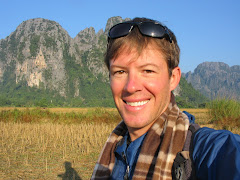
By staying on the south (quiet) end of town, it was easy enough to avoid the craziness found a few blocks north. My guesthouse was run by friendly family and I spent a couple early mornings with the father and his son, Su, drinking coffee around a campfire they had burning out front (easy way to get rid of construction debris). One day was spent on a rented bicycle exploring the city side of the river, and the following day I spent on motorbike checking out the backroads on the far side of the Nam Song. I managed to find my way to some of the most impressive limestone caverns I've ever seen - all the more so, because I had them entirely to myself (if you don't count the numerous Buddha statues that seem to inhabit all Asian caves). Turquiose blue swimming holes, pristine river beaches, beautiful sunrises and sunsets, and the friendly locals and ex-pats that I met topped the whole experience off.
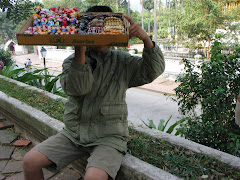
In the end, I guess the whole Vang Vieng thing depends upon your point of view - and your willingness to look the other way if at first you don't like what you see. I won't be so self-rightous as to say that my way is the right way - different strokes for different folks - and it was nice to find that Vang Vieng could accomodate them all.

Turtle Races in Vang Vieng

Two express buses a day make the run north from Vientiane to Vang Vieng - and, unsurprisingly, they're packed to the brim with foreigners hoping to avoid the standard start and stop routine of the local buses. Problem is that between the high demand and an uncoordinated ticket selling system, the seats are routinely over-booked, and our bus was no exception. Not a problem for me and my seat mate (an older Dutch professor who was suddenly traveling solo after his daughter couldn't fly into Bangkok). We had arrived early enough to snag a couple of front row seats. By our scheduled departure time every single seat was full and there were still a half dozen ticket holding passengers standing outside the door. What to do? Well, if you're in Laos (or Cambodia, Vietnam, Thailand, etc..) you fill the aisles with plastic patio chairs and pile on in. Bodies, chairs, and backpacks jamming the aisles, we eventually left Vientiane behind, the overloaded, badly shocked bus bottoming out over every pothole. If nothing else, by sitting up front I had slightly more leg room than most and a clear shot at the door in the event of a rollover. You take what you can get.

I had heard a lot about Vang Vieng before I arrived and, to be honest, I wasn't sure what to expect. It seemed to be one of those passionately love it or absolutely detest it sort of places that have be thoroughly "discovered" by the Lonely Planet-toting, international backpacker set. But given my aversion to long bus rides, Vang Vieng made an obvious midway layover spot between Vientiane and points further north. Besides, I had also heard that no matter your eventual take on the town itself, the scenery and countryside around Vang Vieng is some of the most spectacular in all of Laos. With all of that in mind, I decided to suck it up, stay for a couple of days, and see for myself what it was all about.

This is a good place to mention an event that occurs whenever a bus (over)loaded with backpack-lugging foreigners rolls into a city, town, or village. Backpackers, almost by definition, hardly ever make advanced reservations for accommodations leading, of course, to a scramble for rooms once they arrive. Not much fun to participate in, but always entertaining to watch from the comfort of a sidewalk cafe with cold beer in hand, the "turtle races" are made up of travelers - either singly, in pairs, or often in large groups (herds?) - wandering the streets, guidebooks in hand, racing from guest house to guest house in search of a bed for the night. Technically, there are "snails" (those wearing only an oversize backpack) and "turtles" (those wearing an oversize backpack on their backs with a smaller day pack worn in reverse over the chest). Although a distinct minority, there are also those who masochistically drag their wheeled luggage all over the developing world, but I haven't come up with a name for them yet. At any rate, it's easy to avoid the race by (1) booking ahead, (2) arriving early enough in the day that you're bound to get a spot in your first-choice guesthouse, or (3) hop on the motorbike belonging to the first hotel tout you see and hope for the best.

Arriving in Vang Vieng late in the day on a bus with at least fifty other travelers chomping at the bit for an available bed, I chose option number 3 and it actually worked out perfectly. I ended up in a quiet $5 bungalow in the "local" end of town, immediately dropped my bags, and wandered back to the main drag in search of a much needed meal. By this time the turtles were scurrying this way and that as downtown rooms filled up and, just to stiffen the competition a bit, before long the late bus from Vientiane arrived with a whole new batch of racers. After a quick dinner of laap (Lao meat and mint salad) and sticky rice, I walked down to the Nam Song river and bumped into an American couple, dusty and covered in sweat, dragging their wheeled suitcases through the sand and cobblestones at the rivers edge. They seemed to be lost and rooms - or at least the ones they were willing to pay for -were filling up faster than they could drag their luggage. They were about to completely lose it and I'm pretty sure she had been screaming at him just before I showed up. Feeling a little sorry for them, I offered to help - show them my map, offer a suggestion, something - but they declined and wandered off into the dusk.

But, I had arrived, found a home for the next few days and that was good enough for me. Tomorrow, I'll start sussing out this whole Vang Vieng thing.

Monday, December 1, 2008

Sandalwood City: Vientiane

“Vientiane is exceptional, if inconvenient”, wrote Paul Theroux in 1975, “the brothels are cleaner than the hotels, marijuana is cheaper than pipe tobacco, and opium is easier to find than a cold glass of beer."

Much has changed since one of my favorite travel writers swung through Laos thirty odd years ago. It may have had something to do with the culmination of another successful communist revolution in Southeast Asia (1975 was a big year for the local Reds) and, perhaps more tellingly, the subsequent departure of American USAID and CIA personnel. When the Pathet Lao rolled into town they immediately shut down the local bars and night clubs, sent most of the former regime off to "re-education" camps in the hills, and (no kidding) banished the city's sizable population of prostitutes to an island in the middle of the Mekong.

It turns out that at least some of the hookers could swim, because they're back on the streets plying their trade to an annoying degree. I can't walk more than two blocks at night without an offer ("hey you, you want Lao lady tonight you?") - although, sadly, most of them are coming from the taxi-driver by day/pimp by night dudes. I guess "boom boom" is big business in Vientiane again. Never a group to hide on the sidelines, Katuoys are also on the prowl. Normally the Thai-style Lady Boys are pretty harmless and mildly entertaining in the light of day - they get a little creepier when they start hooting and hollaring at you on a dark street. If you've been to Southeast Asia you know what I mean. Enough said.

At any rate, after the revolution Vientiane began the inexorable socialist slide into economic and cultural oblivian. While things are perking up a bit, and have been for a while, Vientiane could win the world's mellowest capital city award, hands down. I know I've (over)used the term "sleepy riverside town" to describe most of the places I've visited in Laos, but there's no way around it - Laos is full of them, and the biggest of all is Vientiane. Compared to Hanoi, Saigon, and Phnom Penh....well, there's just no comparing (I won't even mention Vientiane and Bangkok in the same breath). Vientiane is more of an oversized town than anything else, which is wonderful, if a little boring when all is said and done. The Buddhist temples are (mostly) beautiful and there are literally dozens of them within the city limits to check out. The food selection - via French cafes, Scandanavian bakeries, Indian and Italian restaurants, the riverside fish stands, a Tex-Mex place, and more - is out of this world, especially when compared to some of the local gruel I've had to endure over the past few weeks. The locals are exceptionally friendly and the touristas definitely entertaining (the Japanese "lotus-eaters" (wiki that one) I'm dorming with are....interesting). As someone told me, the lure of Vientiane is not so much seeing as just being.

And until the Bangkok airports start moving some planes, plenty of ticked off foreigners are just being in Vientiane a little longer than expected. Good thing I'm heading north overland. Next up, Vang Vieng.

Saturday, November 29, 2008

Heading NORTH: Pakse - Savannakhet - Tha Khaek - Vientiane

The past few days have been devoted to a very mellow hopscotch north along Laos Highway 13 - paralleling the Mekong - with brief layovers in the river side towns of Savannakhet and Tha Khaek. The prospect of riding an overnight bus to cover the entire 677 km between Pakse and the capital, Vientiane, in one go was about as appealing as having a jagged piece of bamboo poked up my rear. Conversely, I've found that I can't handle being in a local-style bus for more than about six hours before I start going nuts - due as much to the endless loops of sappy Thai music videos and Cambodian comedy shows played on the bus "entertainment centers" as to the painfully slow progress they make. By cutting the trip into a few sections, I hoped to regain bits and pieces of my soon to be tested patience. At any rate, travel during the day allowed me to see more of the central Lao countryside, although that turned out to be a bit anticlimactic - if you've seen a hundred stilt-houses, you've really seen them all.
Traveling complaints aside, both Savannakhet and Tha Kheak turned out to be pretty pleasant stops. Savannakhet, in particular, is sort of the classic backwater French Indochina administrative capital of old. Lots of decaying French-style buildings lining the riverfront neighborhood streets. The gentrification potential is huge, but alas, no one seems particularly attached to the colonial reminders. A shame from my point of view, but I guess you can't blame the locals for wanting something new and flashy as opposed to old and Frenchy. Anyway, I thoroughly enjoyed wandering the dusty streets and caught a couple spectacular riverside sunsets as I watched the sun sink into Thailand on the far side of the Mekong.
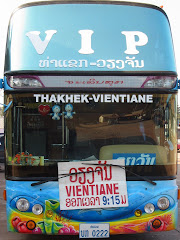
Pulling out of Tha Khaek for the final leg of the journey to Vientiane, I caught an early tuk tuk (taxi) out to the bus station and at the last minute waffled and then folded. Instead of taking my planned "regular" bus I decided to cough up an extra 20,000 kip ($2.50!) for the privilege of riding the two-story "VIP" bus. In addition to negating the necessity of sharing the aisles and (potentially) my seat with locals and\or livestock, the later departure provided a couple hours to mill about the bus station as it slowly came alive for another day - people watching at its best. As a half-awake shopkeeper kept my steaming coffee cup topped off I chatted and mimed with the chain smoking taxi drivers waiting for incoming fares. Perusing the sidewalk food vendors who were assembling I feigned disgust (ok, it was real disgust) at the racks of freshly killed squirrels for sale. Mmmm....furry breakfast, anyone? After a couple hours it was finally time to mount up and head out.
In the end, the VIP bus turned out to be a mixed blessing. It was certainly more comfortable than the regular buses - roomier, fewer Thai music videos, less stops - but being double tiered had the effect of amplifying the swaying back and forth that comes with cruising the Lao "highways." I suffered from a bit of motion sickness - didn't lose breakfast or anything, but it was heading in that direction. After five hours of rollercoasting (as opposed to the 9 hour ride the regular bus provides) we pulled into Vientiane. In the end, it took about three extra days, but was worth every frustrationless second.

Monday, November 24, 2008

Pakse and the Bolevan Plateau

Condom boxes and cockroaches notwithstanding, my trip to the Bolevan Plateau turned out to be really pretty cool. Although I had initially intended to motorbike around the area for a few days, that plan was scuttled as soon as I realized that my possibilities for accomodations may have peaked out with the evening at the Sekong Souksamlane. Instead, I got up early the next morning and spent an entire day picking my way along dirt roads and through dusty villages all the way back to Pakse.

The Bolevan is indisputably beautiful - rising over 3000 feet above the Mekong plain to the west and the Vietnamese border to the east, it is covered in old-growth tropical forests, clear-running rivers, huge waterfalls, and remote villages. It also happens to hold the record for being one of the most heavily bombed areas in the history of warfare - which goes a long way towards explaining the lack of development. UXO (unexploded ordnance) is still a huge problem, as are the lingering effects of defoliants like Agent Orange. Nixon's attempts to disrupt the Ho Chi Minh trail which ran through the province were both amazingly destructive and ultimately futile. Needless to say, I stuck to the main roads.

If the Bolevan has anything going for it besides the spectacular scenery, American scrap metal, and occasional tiger (really), it's the coffee farms that cover its slopes and valleys. Some of the world's finest, and most expensive, coffees are grown here - the legacy of colonial French planters. The coffee farms are going strong today, mostly owned and operated as small family plots, and nearly every home I passed was surrounded by coffee beans drying in the sun on raised racks or tarps on the ground. In one small town, I stopped at a wood framed shop adorned with Tibetan prayer flags blowing in a surprisingly chilly breeze - mostly because the prayer flags seemed so out of place. Immediately a cheerfully caffinated Dutch guy named - seriously - "Koffie" came out to greet me. A self-described coffee freak, Koffie had given up his life in Holland a few years ago to settle in a small town in northern Thailand. After a road trip to Laos, he had met, fallen in love with, and eventually married the daughter of a local coffee grower (seemed a little convenient to me, but hey, love is what it is). This was her shop, he was quick to tell me. She ran the show, while he designed and led educational coffee tours ("from plant to cup") on his new, VERY extended, family's farm.

Koffie turned out to be an amazing guy and, over the freshest pot of Dutch-brewed coffee I've ever had (ok, the only pot of Dutch-brewed coffee I've ever had), we sat on his front porch and chatted about everything from the intricacies of coffee growing, roasting, and brewing to his new life as a member of a big Lao family in a small Lao town. Koffie has been, by far, one of the most interesting and hospitable people I've met on my travels and it was a bit of a bummer to part ways when a new group of coffee-touristas showed up. At any rate, I grabbed a kilo of fresh roasted (like that morning fresh roasted) coffee beans before heading back down the plateau to Pakse - a good way to cut the funk my backpack has developed over the past two months. Anyway, here's my plug for Koffie. Check out: www.paksong.info

Sekong Souksamlane Hotel.....not recommended

Just for the record, if you ever find yourself on the far side of the Bolevan Plateau in a small, dusty town called Sekong, and the sun is sinking fast and you're thinking "man, I'd better find a place to stay tonight....and quick," DO NOT, no matter how desperate you may be (and given the options in Sekong, you will be VERY desperate), stay at the Sekong Souksamlane Hotel. It's the one with the goats and piles of water buffalo shit out front.
After a long day on the back of a motorbike, I made the mistake of following a Lonely Planet recommendation by stopping for the night in Sekong. I quickly found that most of the guesthouses they had listed were no longer in operation - and, of course, by this time it was too late to move on and try my luck in the next village down the road. So, with much trepidation, I checked into about the only place still open - the Sekong Souksamlane. I should have known it was a bad idea when I had to wade through weeds just to get to the front door. Inside was no better - the two story "hotel" looked like a place the Adams Family might stay. Other than a few geckos chasing flies on the dusty walls, there was no one around. Finally, a young disheveled-looking guy came out the shadows and offered me the only room available that evening (which was odd because, after looking through the guest register, I was apparently the only one staying in the entire hotel - in fact, the last guest had left almost a week ago). Without much of a choice, I took the room and settled in. Actually, I barely unpacked, planning to make a quick escape as soon as the sun came up.
After carefully arranging a clean sarong on the bed so (in theory) I could avoid touching the sheets, I took a look at the only piece of furniture in the room - a tall wooden cabinet against the far wall. One of the door was missing and the other was fronted with a cracked mirror. Now, in retrospect, I never should have opened the door, but at the time, I had to see what was inside. Turned out to be a little display I like to call "Lao Still Life." The contents included (1) one dusty drinking glass of dubious origin, (2) one empty cellophane covered, cardboard display box for non-sharpening pencils, (3) one empty bottle of M-150 Thai energy drink, (4) one empty box of "Number 1 Deluxe Top Quality" condoms, (5) one empty foil package of said condoms, and (6) one huge dead cockroach.
Let's just say that, for once, I was very happy to hear the rooster crowing outside my window at 5:00am. By 5:30, as the sun was just cracking over the mountains in the distance, I was gone.

Saturday, November 22, 2008

Don Det to Champa"sick"

Apparently, hammock time isn't as good for your health as you might think. After living the island life for a couple of slow days, I managed to come down with my first real illness of the entire trip - no, not malaria, tapeworms, or even simple giardia (although Emilie's money is on Dengue fever). No, I've been taken out by the common flu. The past two days have been spent mostly curled up in the fetal position underneath my fan, with occasional attempts to choke down a little bread and orange soda. The mere thought of yet another bowl of rice kickstarts the dry heaves. Ok, I'm being slightly dramatic, but still - being sick with something as lame as the flu, in a foreign country sucks. That being said, I did manage my first full meal in 48 hours this evening. It hasn't come up for round two yet - life is looking better.

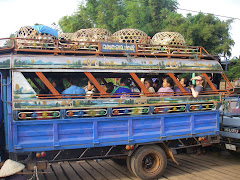
The trip from Don Det (flu island) to my next stop in Chamapasak town was pretty straight forward by Laos standards: river ferry, pickup truck, hitch hike, pickup truck, river ferry, sweaty 2 km hike into town. Made a couple of friends along the way - a Zimbabwean-born Kiwi and a kid from Los Angeles. Between the three of us, we managed to get from point A to point B without too much drama and plenty of Mugabe-bashing all around. The main mode of transport in Laos is the sawngthaew, sort of the bastardized offspring between a pickup truck and tuk tuk. If you happen to see one heading going your way, wave it down, negotiate a fare, and climb into the covered back. If you're lucky, there will be a little room amongst the bodies, livestock, produce, and luggage.

Heading out of Don Det, I wedged in between a couple of betel nut-chewing old ladies and a younger woman carrying a string of (very) freshly caught Mekong catfish - they were still flipping and flapping all over the place. Finally she just tied them up into a ball with some twine and stuffed them into a plastic sack. As I sat down, I accidentally kicked one of the big burlap sacks that was taking up most of the floor and the entire thing jumped up about six inches and started squealing. Then the bag next to it started squealing and thrashing around. The old ladies started cackling and laughing, red betel juice dripping from the corners of their mouths, until one finally shoved the bagged pigs back to the floor. Eventually everything calmed down and off we went, in a cloud of road dust. Minus what I hope to be the tail end of my illness, Champasak turned out to be a pretty cool little place. Sleepy riverside towns seem to be a dime a dozen in Laos but Champasak also has a UNESCO World Heritage Site going for it. About 10 km south of town lies Wat Phu Champasak, an ancient Ankor-era temple complex that, like Angkor, has been slowly reclaimed by the surrounding jungle. Wat Phu Champasak is unique because it was built up the side of the nearby mountain, peaking out at a sacred spring. The spring is still flowing (I took a holy splash bath after my hike to the top) and some of the ruins are being restored with the new UN money. It's no Angkor Wat, but its location is arguably more stunning. Climb to the upper temple and you can look out across the Mekong and beyon eastern Laos into Vietnam. Riding my bike down to the ruins at sunrise let me beat the crowds of tourists that bus in from nearby Pakse - I had the it all to myself, save for a French couple and the Lao women setting up their shrine-side snack snops, for an hour or so.

The rest of the day was spent curled up in a ball on my bed sipping Orange Miranda soda. By evening I was feeling well enough to pedal around town a bit and eat a little. Asleep by 7:00, up with the neighbor's crowing rooster at 4:00am, and off to Pakse after an omlette and cup of Lao coffee. Starting to feel better.